
The Arun-3 Hydro Electric Project stands as a testament to the deepening energy cooperation between India and Nepal. Situated on the Arun River in Nepal’s Sankhuwasabha District, this 900 MW run-of-the-river project is being developed by SJVN Arun-3 Power Development Company (SAPDC), a wholly owned subsidiary of India’s Satluj Jal Vidyut Nigam (SJVN).
The journey of Arun-3 began with a Memorandum of Understanding signed between the Government of Nepal and SJVN on March 2, 2008. Following comprehensive surveys and environmental assessments, the Project Development Agreement was finalized on November 25, 2014. Construction commenced in May 2018, with the project expected to be operational by 2025.
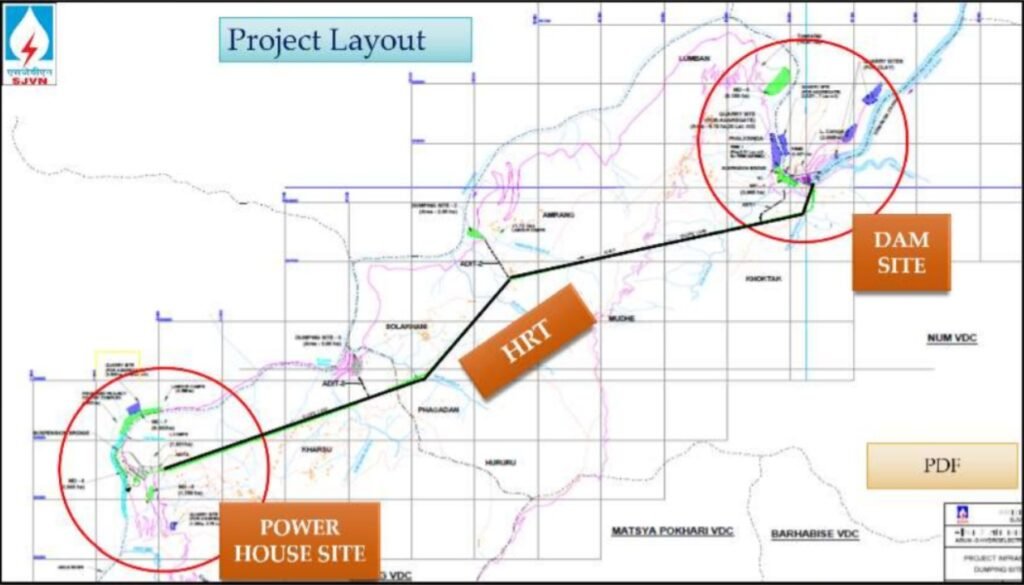
The project’s infrastructure includes a 70-meter-high concrete gravity dam and an 11.74 km headrace tunnel, channeling water to an underground powerhouse equipped with four 225 MW Francis turbines. The generated electricity will be transmitted via a 300 km, 400 kV transmission line from Diding in Nepal to Muzaffarpur in Bihar, India, facilitating cross-border energy exchange.
Under the Build-Own-Operate-Transfer (BOOT) model, SJVN will operate the plant for 30 years, after which ownership will transfer to the Government of Nepal. During this period, Nepal will receive 21.9% of the generated power free of cost, bolstering its energy security.
The Arun-3 project is poised to generate approximately 4,018.87 million units of electricity annually, significantly contributing to the region’s power supply. Beyond energy production, the project is expected to create around 3,000 jobs during its construction phase, fostering economic development in both nations.
Financially, the project represents an investment exceeding $1.6 billion, including over $156 million allocated for transmission infrastructure. In February 2022, SJVN secured a loan of approximately INR 63.33 billion from a consortium of Indian and Nepali banks, underscoring the project’s significance and the collaborative financial commitment of both countries.
Geographically, the Arun River originates in Tibet, flowing through Nepal before joining the Saptakoshi River. The project’s location in the Koshi Province leverages the river’s hydropower potential while aiming to minimize environmental impact through sustainable practices.
The Arun-3 Hydro Electric Project exemplifies the strategic partnership between India and Nepal, aiming to harness shared natural resources for mutual benefit. Its successful completion is anticipated to enhance regional energy cooperation, stimulate economic growth, and contribute to the sustainable development of the Himalayan region.
#Arun3HydroProject #IndiaNepalEnergyCooperation #RenewableEnergy #CrossBorderInfrastructure #SJVN #HydropowerDevelopment
This is an auto web generated news web story.


