Saptrishi Soni।
Every winter, when mustard fields glow yellow and a gentle festive warmth fills the air of southern Haryana, Surajkund quietly transforms into one of India’s most recognisable cultural addresses. What began as a modest attempt to preserve dying crafts has, over the decades, grown into a global cultural phenomenon — the Surajkund International Crafts Mela. Today, it is not merely a fair; it is an institution that reflects Haryana’s cultural confidence, administrative capacity, and people’s participation, while offering the world a living, breathing experience of India’s folk traditions.
The story of Surajkund is not just about handicrafts and handlooms. It is a story of political vision, bureaucratic planning, economic foresight, and social acceptance — all blending seamlessly with the earthy warmth and hospitality that define Haryana.
Inception: A Vision Rooted in Culture
The Surajkund Mela was conceived in 1987 against the backdrop of a rapidly modernising India, where traditional crafts and folk arts were increasingly being pushed to the margins. Haryana, often stereotyped only as an agrarian or industrial state, sought to carve out a cultural identity that showcased its heritage and creative spirit.
The idea was simple yet powerful: create a permanent, annual platform where rural artisans could directly connect with urban and global audiences, free from exploitative middlemen. Surajkund, an ancient reservoir believed to have been built in the 10th century by King Suraj Pal, was chosen as the venue to anchor the fair in historical continuity.
From the outset, the mela was envisioned not as a local exhibition but as a national, and eventually international, cultural congregation. This clarity of purpose set it apart from many short-lived fairs and festivals across the country.
Reasons Behind Starting the Mela
Several compelling reasons converged to give birth to the Surajkund Mela:
Preservation of traditional crafts that were facing extinction due to lack of markets.
Economic empowerment of artisans, especially from rural and tribal regions.
Cultural diplomacy, using folk traditions as a bridge between nations.
Tourism development, positioning Haryana on the global cultural map.
Social integration, bringing together diverse cultures under one roof.
At a time when cultural policy rarely translated into sustained action, Surajkund became an example of how culture could be used as both a developmental and diplomatic tool.
Political Will: The Backbone of Continuity
One of the most striking aspects of the Surajkund Mela is its continuity across political regimes. Governments changed, chief ministers came and went, but the mela not only survived — it expanded in scale, ambition, and reach.
This consistency reflects strong political will across party lines. Haryana’s leadership, irrespective of ideology, recognised that Surajkund had become a valuable cultural asset for the state. Annual budgetary support, policy backing, and administrative priority ensured that the mela was never treated as a symbolic event but as a flagship cultural programme.
The decision to later brand it explicitly as an “International” crafts mela further underscored the political intent to use culture as a soft-power instrument.
Role of Bureaucracy: Strategy, Planning, and Execution
If political will provided direction, bureaucracy provided discipline. The success of Surajkund owes much to meticulous planning and coordination by Haryana’s administrative machinery.
Key bureaucratic contributions include:
Long-term planning rather than ad-hoc arrangements.
Selection and invitation of artisans through transparent, merit-based processes.
Coordination between departments such as tourism, culture, police, health, and urban local bodies.
Infrastructure development, including roads, parking, sanitation, power, and water supply.
Security and crowd management, crucial for an event that attracts millions of visitors.
Over the years, officers posted in Faridabad district and the tourism department have treated Surajkund not as a routine assignment but as a prestige project. Each edition builds upon the learnings of the previous one, reflecting institutional memory and administrative professionalism.
Economic Viability: Culture as Commerce
Surajkund stands as a rare example where culture and commerce coexist without compromising authenticity. Economically, the mela generates value at multiple levels:
Direct income for artisans through stall sales.
Employment generation for local youth in logistics, security, hospitality, and transport.
Boost to tourism, benefiting hotels, restaurants, taxi operators, and local businesses.
Brand value for Haryana, translating into long-term investment and tourism interest.
Artisans often report that sales at Surajkund can sustain them for months. More importantly, the mela offers exposure — bulk orders, export inquiries, and collaborations that extend far beyond the fair’s duration.
The economic model works because the government absorbs organisational costs, allowing artisans to focus solely on their craft and earnings.
Social Acceptance: From Fair to Family Tradition
Perhaps the greatest achievement of Surajkund is its acceptance by the masses. What began as a cultural experiment has now become a family tradition. For many households in Delhi-NCR and beyond, visiting Surajkund is a yearly ritual.
Several factors contributed to this acceptance:
Affordable entry, making it accessible to all sections of society.
A festive environment that combines shopping, food, music, and performances.
Safety and organisation, encouraging women, children, and elderly visitors.
A sense of cultural pride, especially among Haryanvis, who see Surajkund as their own.
The mela’s earthy charm — folk songs echoing in the air, artisans working live on their looms, the aroma of regional cuisines — resonates deeply with people tired of malls and monotony.
International Reach: Craft as Cultural Diplomacy
Surajkund’s international dimension has steadily grown over the years. Artisans and performers from Asia, Africa, Europe, and Latin America now see participation as a matter of prestige.
The introduction of a “Theme Country” concept was a masterstroke. Each year, a partner nation’s culture is highlighted through pavilions, performances, and cuisine, turning the mela into a living global village.
This approach has achieved multiple objectives:
Strengthening people-to-people connections.
Providing Indian audiences exposure to world cultures in an accessible format.
Enhancing India’s cultural diplomacy without formal negotiations.
From SAARC nations to African and European countries, Surajkund has quietly done what many official forums struggle to achieve — building goodwill through shared cultural experiences.
State-wise Representation: India in One Space
Equally significant is the mela’s pan-India character. Almost every Indian state participates, showcasing its unique crafts, textiles, and traditions. From Kashmir’s papier-mâché to Kerala’s coir, from Rajasthan’s pottery to the Northeast’s bamboo art, Surajkund becomes a microcosm of India.
This state-wise representation reinforces national integration, reminding visitors that diversity is not a challenge but India’s greatest strength.
Surajkund as Part of Haryana’s Cultural Identity
Over time, Surajkund has become inseparable from Haryana’s cultural identity. It has reshaped perceptions of the state, presenting it not just as a land of farms and factories but as a custodian of culture and creativity.
The mela reflects Haryana’s values:
Hospitality that treats guests as family.
Simplicity blended with confidence.
Respect for labour, skill, and tradition.
It has also inspired local pride, with residents acting as informal ambassadors for the event.
Role of the Haryana Government
The Haryana government’s role extends beyond funding. It has acted as curator, facilitator, and guardian of the mela’s ethos. Decisions such as maintaining quality control, resisting excessive commercialisation, and prioritising artisans over corporate interests have preserved Surajkund’s soul.
By continuously upgrading facilities while protecting traditional aesthetics, the government has struck a delicate balance between growth and authenticity.
Role of the People: The Heartbeat of Surajkund
Above all, Surajkund belongs to the people — the artisans who travel thousands of kilometres, the performers who bring folk traditions alive, the visitors who return year after year, and the local residents who welcome the world with open arms.
Their collective participation transforms Surajkund from an event into an experience.
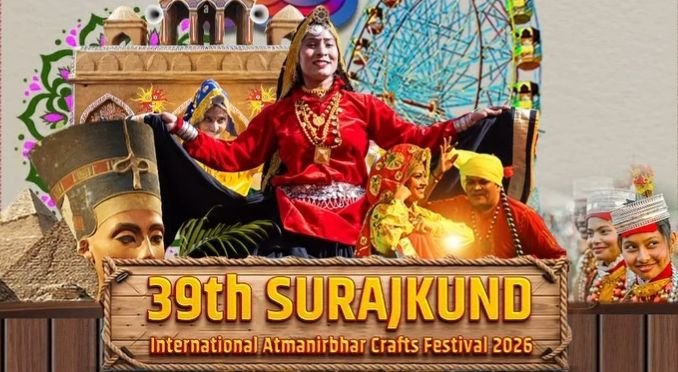
In conclusion, no account of the Surajkund International Crafts Mela is complete without acknowledging the pivotal role played by the Public Relations Department of the Haryana government. Over the years, this department has worked quietly yet strategically to give the mela its national and international visibility. From curating authentic narratives around artisans and their crafts, to disseminating timely and credible information about events, theme nations, cultural performances, and facilities, the PR machinery has ensured that Surajkund is not just visited but widely talked about. Through sustained engagement with national and international media, cultural bodies, diplomatic missions, and digital platforms, the department has transformed the mela into a premium cultural brand. Its efforts have helped project Haryana as a culturally vibrant and administratively capable state, while ensuring that the voices of artisans, the vision of the government, and the spirit of the people reach audiences far beyond Surajkund’s physical boundaries. In many ways, the Public Relations Department has acted as the bridge between the ground reality of the mela and the global imagination, turning a regional cultural fair into an internationally recognised newsworthy event year after year.
The Surajkund International Crafts Mela is not just an annual fair; it is a living example of how culture, governance, and people can come together to create something enduring. It shows that with vision, planning, and participation, traditions can be preserved without freezing them in time.
In the colours of its crafts, the rhythms of its folk music, and the warmth of its people, Surajkund carries the soul of Haryana — rooted in the soil, open to the world, and confident of its identity. That is why, year after year, it continues to generate not just noise, but meaning, memory, and pride.


