

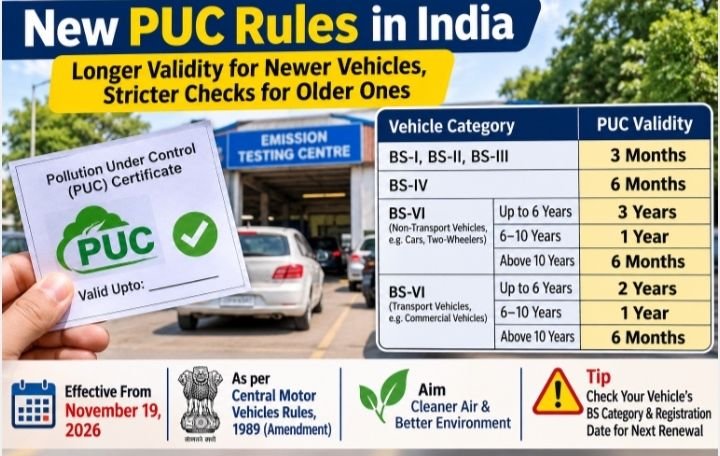
New amendment to Central Motor Vehicles Rules, 1989, links pollution certificate renewals to emission standards, vehicle age and usage category; older vehicles will continue to face more frequent testing
The Central Government has introduced a major change in India’s vehicle pollution certification system, revising the validity of Pollution Under Control (PUC) certificates according to emission standards, vehicle age and whether a vehicle is used for private or commercial purposes. The new framework offers considerable relief to owners of newer BS-VI vehicles, while requiring older vehicles to undergo pollution checks more frequently.
The Ministry of Road Transport and Highways has amended the Central Motor Vehicles Rules, 1989, through the Central Motor Vehicles (Sixteenth Amendment) Rules, 2026. The amendment was notified through G.S.R. 991(E), dated November 13, 2026, and came into force upon its publication in the Official Gazette on November 19, 2026. It modifies Rule 115, which governs Pollution Under Control certification.
The revised provisions establish different renewal schedules for BS-I, BS-II, BS-III, BS-IV and BS-VI vehicles. For the first time under this revised schedule, the age of a BS-VI vehicle and its transport or non-transport classification will determine how frequently its pollution certificate must be renewed.
New PUC validity schedule
Under the amended rules, vehicles complying with BS-I, BS-II and BS-III emission standards will have a PUC certificate validity of three months. For BS-IV vehicles, the validity will be six months.
The most significant change concerns BS-VI vehicles, for which the government has introduced an age-based renewal system.
BS-VI non-transport vehicles, including private cars and two-wheelers:
– Up to six years from first registration: PUC valid for three years.
– More than six years and up to 10 years: renewal every year.
– More than 10 years: renewal every six months.
BS-VI transport vehicles, including commercial vehicles:
– Up to six years from first registration: PUC valid for two years.
– More than six years and up to 10 years: renewal every year.
– More than 10 years: renewal every six months.
Existing certificates will not become invalid immediately
The amendment also provides a transition period for motorists who already hold valid PUC certificates. Existing certificates will continue to remain valid for their originally specified period. The revised schedule will apply only when such certificates come up for their first renewal after the new rules have taken effect.
Another important provision concerns the timing of renewal. If a vehicle owner applies for renewal within the 10 days immediately preceding the expiry of the existing certificate, the renewed certificate will take effect from the existing certificate’s expiry date. If renewal is sought after the certificate has expired, the new certificate will become effective from the actual date of renewal.
Why the government has changed the rules
The Ministry’s stated objective is to align pollution testing requirements with the age and emission performance of vehicles. Newer BS-VI vehicles are subject to stricter emission standards, and the extended validity is intended to reduce the compliance burden on owners of newer, cleaner vehicles. At the same time, shorter renewal periods for older vehicles retain a mechanism for monitoring emissions from vehicles that have been on the road for longer.
The amendment is also important for India’s broader efforts to improve air quality and strengthen vehicle-emission compliance. While newer vehicles will benefit from fewer visits to authorised pollution-testing centres, owners of older vehicles will need to pay closer attention to renewal deadlines.
Vehicle owners should check their vehicle’s Bharat Stage category, date of first registration and transport classification before calculating their next PUC renewal date. The new provisions do not mean that all BS-VI vehicles automatically receive three-year certificates: the longer validity applies only to eligible non-transport vehicles up to six years old, while the corresponding period for transport vehicles is two years.
The revised framework is now in force following its publication in the Gazette, and motorists will need to follow the applicable schedule when their existing certificates come up for renewal.

