
Congress leader questions restrictions on movement in the capital, alleges electoral manipulation and vows to continue the fight over voter rolls
— India’s Leader of Opposition in the Lok Sabha, Rahul Gandhi, has accused Prime Minister Narendra Modi’s government of protecting Chief Election Commissioner Gyanesh Kumar, intensifying the political confrontation over electoral rolls and the independence of the Election Commission of India.
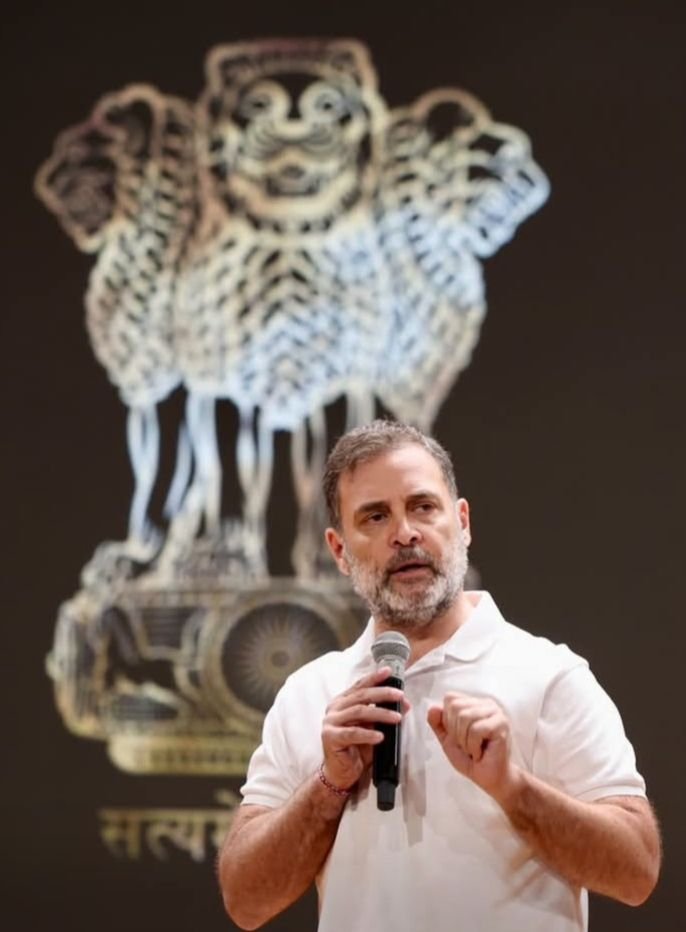
Speaking at a press conference at the Congress headquarters on Monday, Gandhi criticised the extensive security arrangements across the national capital ahead of a planned INDIA bloc march towards the Supreme Court. Opposition parties are demanding Kumar’s resignation and challenging the Election Commission’s Special Intensive Revision (SIR) of electoral rolls.
“Why is Delhi under siege?” Gandhi asked, questioning restrictions on public movement and reports that people travelling to the capital were being prevented from reaching protest sites.
He alleged that the government’s response was intended to shield the election chief from public scrutiny. The Election Commission and the ruling Bharatiya Janata Party (BJP) have rejected opposition allegations of political bias in the electoral process. <Cite refs={[“turn997311search6″,”turn997311news37”]}/>
‘The Government Is Protecting Gyanesh Kumar’
Gandhi said protests against the Election Commission and alleged vote theft had intensified in Delhi over the preceding four to five days, describing the demonstrations as part of a wider political resistance that had been building for years.
He argued that the heavy deployment of security personnel was drawing attention to the very issue the government wanted to contain.
According to Gandhi, between 20,000 and 30,000 police personnel had been deployed across the capital. He questioned why trains and buses were allegedly being stopped and why people were facing difficulties reaching Delhi during the demonstrations.
The Congress leader said his party wanted the public to see the government’s response to the protests and claimed that the Prime Minister was shielding Kumar from accountability.
His remarks came as opposition parties prepared to take their campaign from the streets to the Supreme Court, seeking judicial intervention over the controversy surrounding the electoral revision exercise. <Cite refs={[“turn997311search3″,”turn997311search4”]}/>
SIR Controversy at the Centre of the Political Battle
The dispute centres on the Special Intensive Revision of electoral rolls, a process undertaken by the Election Commission to verify voter registrations and update electoral lists.
The opposition has raised concerns that the exercise could lead to eligible voters being removed from the rolls, particularly among vulnerable communities. It has also questioned the transparency of the process and demanded greater accountability from the election authorities.
The Election Commission maintains that electoral roll revisions are intended to improve the accuracy of voter lists by identifying ineligible, duplicate or otherwise invalid entries. The BJP has denied allegations that the process is designed to benefit the ruling party.
The controversy has intensified following reports of disagreements within the Election Commission over aspects of the revision exercise. Opposition parties have cited those reports to strengthen their demand for greater transparency and an independent assessment of the allegations.
The central question is whether the revision process is being implemented in a manner that protects every eligible citizen’s right to vote. Establishing whether any deletions were improper, and whether they resulted from administrative errors or deliberate interference, requires examination of the relevant records and evidence.
Allegations of Police Excesses
Gandhi also criticised the handling of demonstrations in Delhi, alleging that young protesters had been subjected to police action while members of organisations aligned with the ruling establishment were allowed greater freedom.
He claimed that police personnel and members of central security forces were themselves questioning the instructions they had received. He further alleged that some protesters had been assaulted and that the restrictions were disproportionate.
These claims were made by the opposition leader and were not independently established during his press conference.
Gandhi said the government’s response was strengthening, rather than weakening, the opposition’s resolve. He portrayed the confrontation as a broader struggle over constitutional rights, democratic accountability and the independence of institutions responsible for conducting elections.
The security arrangements have become a separate source of political contention. Delhi authorities have imposed restrictions and increased deployments in anticipation of demonstrations, while opposition leaders argue that such measures are obstructing peaceful protest.
INDIA Bloc Turns to the Supreme Court
The planned march reflects the opposition’s decision to pursue its demands through both public mobilisation and legal channels.
Gandhi said opposition leaders intended to approach the Supreme Court over the Election Commission controversy and press for action against the CEC. The INDIA bloc’s demands include Kumar’s resignation and a review of the disputed electoral revision process. <Cite refs={[“turn997311search4″,”turn997311search5”]}/>
The legal challenge places the judiciary in a politically sensitive position. The Supreme Court’s role will be to consider the issues brought before it in accordance with the law, rather than to determine the dispute on the basis of competing political claims alone.
At the heart of the controversy is public confidence in the electoral system. The Election Commission is a constitutional body entrusted with conducting elections, and its credibility depends not only on the legality of its decisions but also on transparency, impartiality and public trust.
Gandhi also directed a personal warning at Kumar, demanding that he resign and alleging that the controversy extended beyond the election chief himself. He claimed that the opposition possessed information about alleged wrongdoing, although the specific evidence behind those assertions was not established at the press conference.
The CEC has not been shown in the cited reports to have been found guilty of the wrongdoing alleged by the opposition.
A Test of Democratic Accountability
The confrontation presents a significant challenge for both the government and the opposition. For the Congress and its allies, the SIR dispute has become an opportunity to raise wider questions about voting rights, institutional independence and the treatment of dissent.
For the government and the Election Commission, the immediate challenge is to address public concerns about the revision process while ensuring that eligible voters are not unfairly excluded and that electoral rules are applied consistently.
The dispute also raises questions about the balance between maintaining public order and protecting the right to peaceful protest. Security measures may be necessary when large demonstrations are expected, but their scope and implementation remain legitimate subjects of public scrutiny.
Whether the opposition’s allegations lead to judicial intervention, changes in electoral procedures or a wider political movement remains uncertain. What is clear is that the row over voter lists has developed into a larger contest over the credibility of India’s democratic institutions.
As the INDIA bloc prepares to pursue its case before the Supreme Court, the focus will increasingly shift from political accusations to evidence, legal scrutiny and the Election Commission’s ability to demonstrate that the electoral process is fair, transparent and accessible to every eligible voter.

