Haryana’s Monsoon Session of the Legislative Assembly has entered an increasingly confrontational phase, with the ruling BJP and the Congress locked in a political dispute over the conduct of legislators, alleged mistreatment of Opposition MLAs and the use of parliamentary privilege proceedings.
The latest flashpoint came on Monday when the Assembly admitted two separate privilege motions against Congress MLAs Jassi Petwar and Induraj Narwal. The motions were moved by BJP leaders following the confrontation between Congress legislators and security personnel at the Assembly complex last week. The matter has now been referred to the Assembly’s Privileges Committee for examination.
The development has added another layer to an already tense session, which has seen sharp exchanges between the BJP government led by Chief Minister Nayab Singh Saini and the Congress Opposition led by former chief minister Bhupinder Singh Hooda.
At the heart of the dispute is the confrontation of August 27, when Congress legislators protested over what they described as the ill-treatment of their colleagues by security personnel while entering the Assembly. Congress has demanded an impartial inquiry into the incident, while the BJP has accused Opposition members of conduct unbecoming of legislators.
The political dispute subsequently moved from the Assembly gates to the floor of the House.
During Monday’s proceedings, BJP minister Ranbir Gangwa moved a privilege motion against Jassi Petwar, accusing him of making allegedly defamatory remarks against Assembly Speaker Harvinder Kalyan on social media. BJP MLA Laxman Singh Yadav separately moved a privilege motion against Congress MLA Induraj Narwal, accusing him of allegedly snatching and throwing away a poster that Congress MLA Jarnail Singh had displayed in the House.
The Speaker admitted both motions and referred them to the Privileges Committee, which is expected to examine the allegations and report its findings to the Assembly.
For the BJP government, the privilege proceedings are being presented as a question of maintaining the dignity and institutional authority of the legislature. For the Congress, the episode is part of a larger dispute over the treatment of Opposition legislators and what it sees as an attempt to shift attention away from the original confrontation.
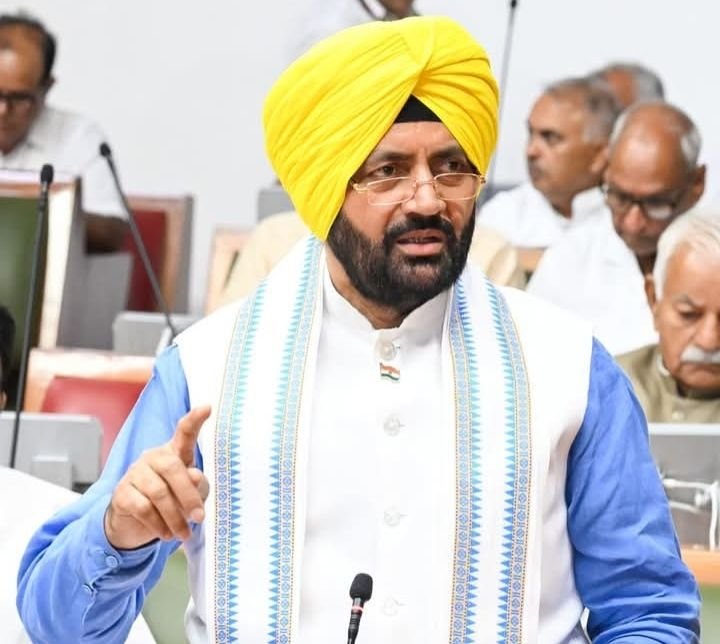
The political disagreement was further sharpened when Chief Minister Nayab Singh Saini and Hooda exchanged views over language used during the proceedings.
Hooda objected to a word used by the Chief Minister while referring to Congress members, arguing that it was inappropriate for parliamentary proceedings. Saini defended his remarks, saying the context in which they were made needed to be considered and that he had responded to the Opposition’s conduct.
Speaker Harvinder Kalyan subsequently intervened and sought to maintain decorum in the House. The issue illustrates how quickly political rhetoric outside the Assembly can become part of the formal proceedings inside it.
The Congress later staged a symbolic walkout, with Hooda maintaining that elected representatives should not be subjected to force by security personnel. The ruling side, however, has continued to argue that the dignity and discipline of the House must be protected.
The confrontation is significant because the privilege mechanism is one of the strongest parliamentary tools available to a legislature for dealing with conduct considered to breach the privileges or dignity of the House.
A privilege motion is not simply another political resolution. Once admitted, it can lead to a formal examination of the conduct of a legislator, with the Privileges Committee considering evidence and circumstances before making recommendations.
The current controversy therefore has the potential to continue beyond the Monsoon Session itself.
But the political battle inside the Assembly is not limited to the August 27 confrontation.
The Congress has sought to use the session to raise wider concerns about governance, employment, law and order, recruitment and the functioning of Haryana Kaushal Rozgar Nigam, while the BJP government has defended its record and accused previous Congress administrations of having relied extensively on contractual employment.
The HKRN issue has become another major political fault line. Congress members have alleged irregularities and questioned transparency, reservation provisions and the use of contractual recruitment as an alternative to regular government appointments.
The government, however, has argued that contractual employment existed long before HKRN and that the present system has reduced the role of contractors and middlemen by introducing a more structured deployment mechanism. Chief Minister Saini has said HKRN provides benefits such as EPF, ESI, maternity benefits and other safeguards to workers.
The government has also cited financial savings resulting from replacing contractor commissions with the HKRN system.
For young people in Haryana, the debate over contractual employment has particular importance. Government jobs remain highly sought after in the state, and the distinction between permanent recruitment and contractual employment has implications for job security, salaries, promotions, retirement benefits and social protection.
This makes the HKRN controversy potentially more consequential politically than the immediate Assembly confrontation.
At the same time, the Assembly has been dealing with legislative business.
Four Bills were introduced during the Monsoon Session covering courts, municipal governance, municipal corporations and the management of Baba Shri Khatu Shyam Chulkana Dham. The Haryana Assembly’s official list of business confirms the proposed legislation, including the Bill relating to the Chulkana Dham shrine.
One of the municipal amendments seeks to remove the requirement for a separate municipal trade licence for meat shops and slaughterhouses, while food-safety and other regulatory requirements would continue to apply.
Another significant measure concerns Chulkana Dham in Panipat district. The proposed legislation seeks to establish a dedicated shrine board for the management and administration of the religious site.
The proposal has attracted political and public interest because it would bring the management of the shrine, its funds, land and associated properties under a statutory framework. The proposed board is to have the Chief Minister as its chairperson, with other government-appointed members.
The legislation demonstrates how the Assembly’s agenda extends beyond political confrontation. The government is simultaneously attempting to push through administrative and institutional changes that could have long-term consequences for municipal governance and religious-site management.