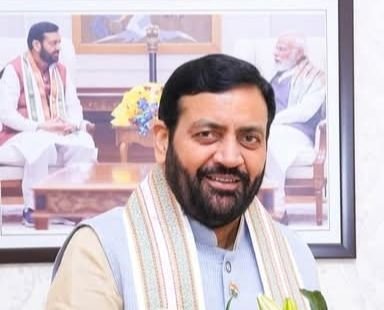
In a significant administrative and political development, the Haryana government led by Nayab Singh Saini has initiated strong action in connection with an alleged ₹590 crore fraud linked to a private bank. The state has handed over the investigation to the Central Bureau of Investigation, signaling the seriousness of the case and its potential implications within the administrative framework.
As part of the immediate response, two senior Indian Administrative Service officers—Pradeep Kumar and Ram Kumar Singh—have been placed under suspension. Both officers are suspected to have possible links to the alleged financial irregularities, though the extent of their involvement is yet to be established through formal investigation.
According to official orders, Pradeep Kumar, who was serving as Special Secretary and State Transport Director in the Transport Department, has been suspended under Rule 3(1) of the All India Services (Discipline and Appeal) Rules, 1969. During the suspension period, he has been directed to report to the Haryana Government’s Services-I Branch in Chandigarh. The order was issued under the authority of Chief Secretary Anurag Rastogi, indicating that the decision was taken at the highest administrative level.
Similarly, Ram Kumar Singh, who held the position of Special Secretary in the Revenue and Disaster Management Department, has also been suspended. In addition to his primary role, he was serving as the Additional Chief Executive Officer of the Panchkula Metropolitan Development Authority, a position that placed him in a key administrative and developmental role within the state.
The decision to suspend both officers ahead of the completion of the investigation reflects a precautionary approach aimed at ensuring an impartial probe. It also underscores the government’s attempt to maintain administrative integrity while the case unfolds.
The alleged fraud, pegged at around ₹590 crore, is believed to involve serious financial misconduct within a private banking institution, though specific operational details of the scam are still emerging. The scale of the financial irregularity has raised concerns about regulatory oversight, institutional accountability, and the possible nexus between financial entities and administrative officials.
By entrusting the probe to the Central Bureau of Investigation, the Haryana government appears to be seeking a comprehensive and credible investigation, especially given the involvement of senior bureaucrats. The move is also likely aimed at insulating the process from local pressures and ensuring transparency.
From a governance perspective, the development has broader implications. It highlights the increasing scrutiny on administrative conduct and the need for robust checks within the system. At the same time, it raises questions about how such large-scale financial irregularities went undetected and whether there were systemic lapses in monitoring mechanisms.
Politically, the action sends a message of zero tolerance toward corruption and administrative misconduct. However, the outcome of the investigation will be crucial in determining whether this case remains an isolated incident or points to deeper structural issues within the governance and financial ecosystem.
As the investigation progresses, attention will remain focused on the findings of the central agency and any further action that may follow. The case has already emerged as a key test of administrative accountability and institutional response in Haryana.