
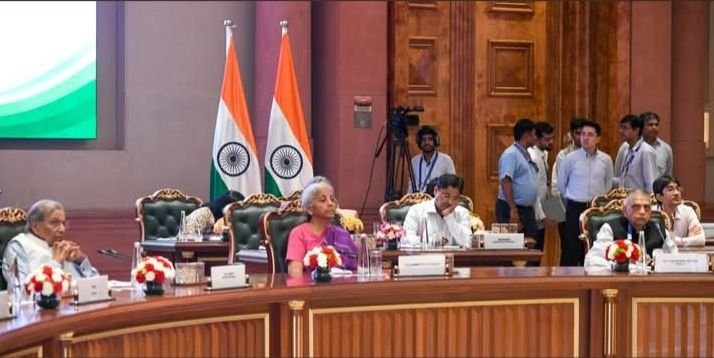
New Delhi — Union Finance and Corporate Affairs Minister Nirmala Sitharaman chaired the inaugural session of a two-day conference bringing together finance ministers, finance secretaries and senior officials from states and Union Territories to examine how India can mobilise the financial resources needed to sustain its long-term development journey towards Viksit Bharat 2047.
The conference, titled “Financing India’s Journey Towards Viksit Bharat”, is being organised by the Union Ministry of Finance in New Delhi on September 18 and 19. Several Chief Ministers, state finance ministers and senior government officials are participating in the discussions, which are aimed at strengthening coordination between the Centre and the states on economic and fiscal priorities.
The discussions come at a time when the financing requirements of India’s next phase of growth are becoming increasingly complex. While public expenditure remains central to infrastructure and social development, the conference is also examining ways to encourage greater private investment and improve the efficiency of financial resources.
Department of Economic Affairs Secretary Anuradha Thakur said private-sector financing would have to play an important role in India’s development ambitions because the scale of transformation envisaged for 2047 could not be achieved through government budgets alone. The conference brings together policymakers, economists, academia, industry and the financial sector to consider both public and private financing requirements.
A major objective of the meeting is to identify areas where Centre and state policies can complement each other. Rather than treating financing as a purely budgetary question, the conference is examining the wider economic architecture required to support sustained growth, productive investment and structural transformation.
The inaugural programme includes a keynote address by N.K. Singh, former chairman of the 15th Finance Commission and President and Life Trustee of the Institute of Economic Growth. Former Maharashtra Additional Chief Secretary and Finance Secretary Sudhir Shrivastava is presenting a state-level perspective on financing the Viksit Bharat objective.
The conference has been structured around three broad themes: the macroeconomic outlook, financing agricultural transformation and financing the energy transition.
The macroeconomic discussions are expected to examine India’s growth trajectory and the financial pathways required to sustain it. Participants are also considering the implications of GST 2.0 for states, along with possibilities for private financing and ways to strengthen the fiscal capacity required for long-term investment.
Agriculture is another major area of discussion, with the conference examining financing for agricultural markets and marketing, along with mechanisms to support resilience and sustainable use of natural resources. The focus reflects the importance of ensuring that economic growth is accompanied by structural changes in the rural and agricultural economy.
The energy transition forms the third major theme. Discussions include financing renewable-energy and transmission infrastructure as well as emerging areas such as carbon capture, utilisation and storage. The objective is to examine how large-scale investment in cleaner energy systems can be financed while supporting India’s wider economic expansion.
The conference is also looking beyond the immediate financial cycle. Officials from the Ministry of Statistics and Programme Implementation and the Ministry of Electronics and Information Technology are contributing to discussions on measuring development outcomes and the role of new technologies in improving governance.
Revenue Secretary Arvind Shrivastava has also called for states to progressively raise capital expenditure to around 3 per cent of Gross State Domestic Product by 2031-32, highlighting the role of state-level investment in building productive capacity for India’s longer-term development.
The broader significance of the conference lies in its attempt to bring the Centre and states around the same table on questions that will shape India’s economic priorities over the coming decades. With infrastructure, agriculture, energy, technology and climate-related investment all requiring substantial financial resources, the discussions are focused on how different sources of capital can be brought together without losing sight of fiscal sustainability.
The two-day meeting therefore represents an effort to move the conversation on Viksit Bharat beyond broad development targets and towards the practical question of how that transformation will be financed. Its emphasis on Centre-State coordination, private investment and sector-specific financing is expected to feed into the wider policy discussion on India’s development strategy towards 2047.

